Spring Coiling Process

Core Manufacturing Process

Spring Coiling Process

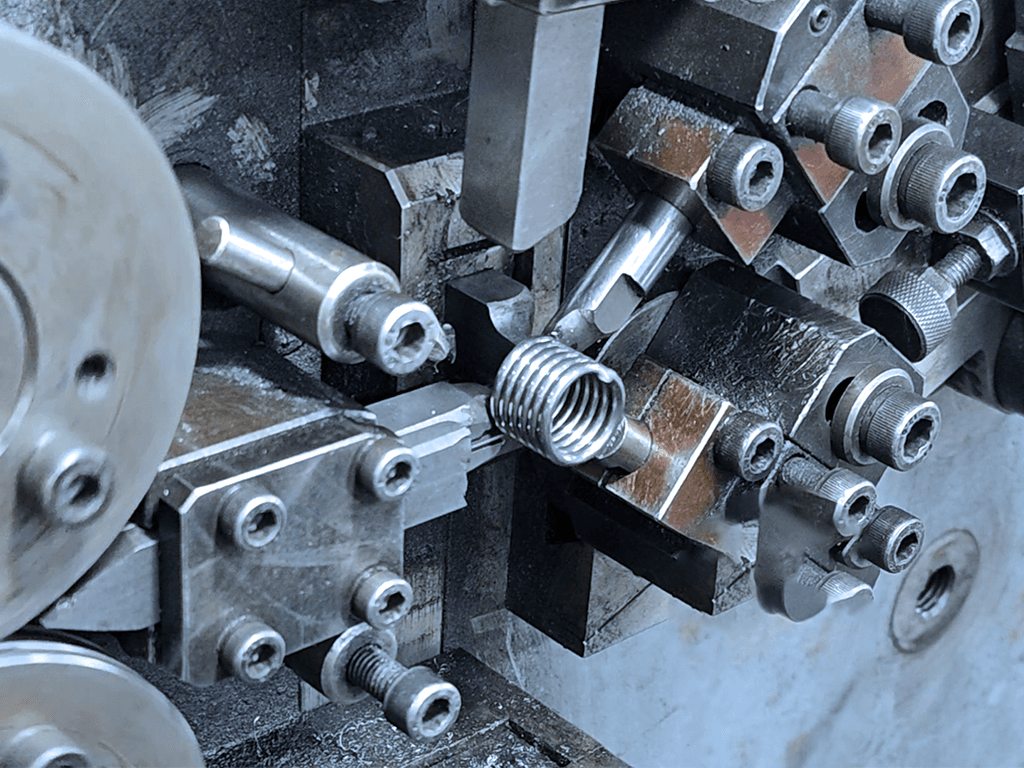
Coiling is the forming starting point of spring manufacturing. How well wire diameter, coil diameter, pitch, winding direction, and end structure are controlled directly affects spring load, service life, and batch consistency.

View Surface Treatment
Spring wire forming and coiling process

Turning design parameters into stable, repeatable production capability

Spring coiling is more than winding steel wire into a helix. For procurement and engineering teams, what matters more is whether the supplier can link drawing parameters, equipment settings, heat-treatment curves, and inspection standards into a repeatable production flow.

When Dingli Spring receives a drawing or sample, we first confirm the material grade, wire diameter, outer diameter, free length, total coils, active coils, pitch, winding direction, end structure, target load, operating environment, and surface treatment requirements, then choose a path: standard-part substitution, sample validation, or custom volume production.

After coiling, the parts go through stress-relief tempering, end processing, presetting, surface treatment, marking and packing, and final inspection. Every operation centers on dimensional stability, load stability, and batch traceability.

PROCESS CAPABILITY

Coiling Capability and Process Control

We set manufacturing control points around wire diameter range, spring type, dimensions and load, and batch traceability, helping procurement and engineering teams assess custom feasibility, lead time, and stable supply capability.

0.1-16mmWire Diameter RangeConfirmed by spring type, material, and equipment station
4 TypesMain CategoriesCompression, extension, torsion, and wire forming
Dimensions/LoadControl FocusGeometry and mechanical performance addressed together
Batch TraceabilityShipment RecordsSupporting quality re-checks and repeat orders
MANUFACTURING FLOW

Production flow from drawing review to inspection and packing

Starting from parameter confirmation and moving through CNC forming, stress-relief tempering, end processing, presetting, surface treatment, and inspection and packing, we build a verifiable, traceable spring manufacturing path.

  1. Spring Design and Drawing Review
    01
    ENGINEERING REVIEW

    Spring Design and Drawing Review

    Based on the drawing, sample, or application conditions, we confirm the material, wire diameter, outer diameter, free length, active coils, pitch, winding direction, end structure, and target load. Where needed, we run sample validation first to avoid repeated rework on parameters during volume production.

  2. CNC Coil Forming
    02
    CNC COILING

    CNC Coil Forming

    The wire is fed into the CNC coiling equipment, where wire feed, mandrel, guide wheels, and forming tools control coil diameter, pitch, number of coils, and winding direction. Compression springs, extension springs, torsion springs, and wire-formed parts are matched to different stations as appropriate.

  3. Stress-Relief Tempering
    03
    STRESS RELIEF

    Stress-Relief Tempering

    After coiling, residual stress remains inside the spring, so the tempering temperature and holding time are set according to the material and specification. The goal of heat treatment is to stabilize elasticity, reduce the risk of deformation, and lay the foundation for subsequent load consistency.

  4. End Grinding and Shaping
    04
    END GRINDING

    End Grinding and Shaping

    Compression springs that require even load bearing undergo end grinding, with straightening, deburring, or shaping carried out as the drawing requires. End quality affects spring squareness, installation stability, and long-term load conditions.

  5. Presetting Treatment
    05
    SETTING

    Presetting Treatment

    Springs with stable-load requirements undergo presetting, which releases part of the plastic deformation in advance and reduces free-height loss during use. This operation is especially suited to die springs and high-frequency working springs.

  6. Surface Treatment and Color Identification
    06
    SURFACE FINISHING

    Surface Treatment and Color Identification

    Depending on rust protection, appearance, and industry identification requirements, surface treatments such as electrophoresis, spray coating, black oxide, zinc plating, nickel plating, or Dacromet are selected. Die springs can also be color-coded by load grade for easier storage and assembly identification.

  7. Marking, Inspection, and Packing
    07
    INSPECTION & PACKING

    Marking, Inspection, and Packing

    Before shipment, finished parts are checked for dimensions, load, appearance, quantity, and batch information. To customer requirements, we can add parameter marking, separate bagging, labeling, rust-proof packing, or export packing, making warehousing, assembly picking, and later traceability easier.

WHY DINGLI

Why Choose Dingli's Coiling Process

Long-term supply customers care most about delivery stability, batch consistency, and the cost of repeat orders. Dingli builds a closed loop from parameter assessment, equipment matching, and heat treatment to inventory coordination and shipment records.

01Parameter Assessment Up Front

Before quoting, we confirm the drawing, material, load, service life, and operating environment, reducing communication costs at the sample stage.

02Equipment Station Matching

We select the right coiling equipment, tooling, and forming method by spring type and wire diameter to ensure batch consistency.

03Closed-Loop Heat Treatment

After coiling, stress-relief and dimensional-stabilization processing keep the spring's load performance more stable over long-term operation.

04Standard Parts and Custom in Parallel

Common die springs can be matched against stock first; non-standard springs can be custom-made to drawing, sample, or application scenario.

05Complete Inspection Records

Shipment confirmation covers dimensions, load, appearance, and batch information, making later quality re-checks and repeat orders easier.

06Built for Supply Delivery

We support batch deliveries, packing and marking, and long-term supply communication, suited to equipment makers, mold shops, and automation customers.

Information to Confirm for Quoting and Sampling

The more complete the information, the faster the engineering judgment. If you don't have a full drawing, you can first send sample photos, the installation position, and operating conditions, and we will help define the key parameters.

  • Structural parameters: wire diameter, outer diameter, inner diameter, free length, total coils, active coils, winding direction, end structure.
  • Performance requirements: working travel, target load, compressed height, extended length, torsion angle, service-life or frequency requirements.
  • Material and surface: 65Mn, 50CrVA, stainless steel, music wire, plus requirements such as black oxide, zinc plating, spray coating, electrophoresis, and rust-proof packing.
  • Procurement information: sample quantity, batch quantity, target lead time, packing method, and whether long-term supply or batch delivery is needed.

Need to evaluate a spring coiling or custom solution?

Send the drawing, sample photos, material, quantity, and application conditions, and Dingli Spring will provide practical manufacturing recommendations based on the production process, surface treatment, and delivery requirements.

View Surface Treatment